The Psychology of Digital Faces: Why We Feel Emojis
We like to think that a smiley face means "I'm happy." But in the digital wild, that same yellow circle can be a peace offering, a sarcastic insult, or a terrifying display of passive-aggressive rage. Welcome to the "Meaning Void."
Communication is 70% non-verbal. When we moved our lives into text boxes, we committed a linguistic suicide of sorts—we stripped away the tone, the eyes, and the hands. Emojis are our attempt at a resurrection. But they aren't a perfect science. They are a digital Rorschach test: what you see says more about *your* brain than the sender's intent.
The Universal "Face area" Hack
Why do we care so much about a 20-pixel icon? Because your brain thinks it's alive. The Fusiform Face Area (FFA) is a hardware-encoded part of your brain designed for one thing: spotting faces. It's the reason you see a "man in the moon" or a face in a burnt piece of toast.
Research from Flinders University in 2014 proved that we've physically rewired our FFA. When you look at a 😊, your brain triggers the exact same neural sequence as if you were looking at a living, breathing human. This is why a text without an emoji feels "cold." Your brain is literally searching for a face to verify the person's intent, and when it finds nothing, it defaults to Digital Paranoia.
Valence vs. Arousal: The Emotional GPS
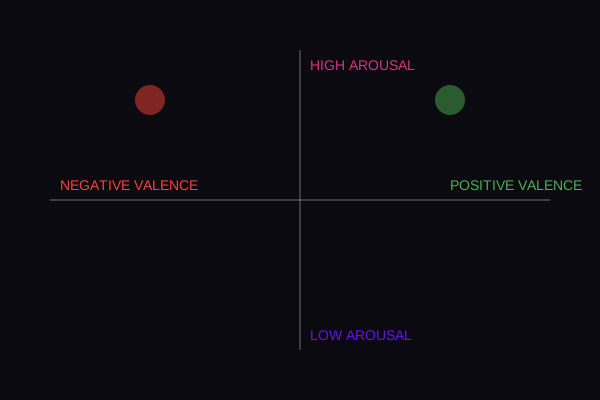
To understand why one emoji works while another fails, you need to understand the Circumplex Model of Affect. Basically, your brain tracks emotions on two coordinates: Valence (Is it good or bad?) and Arousal (Is it calm or intense?).
The "Ambiguity" Zone
Text: "I'm on my way."
Valence: ?
Arousal: ?
The brain assumes the worst. Are they late? Are they mad?
The "Clarity" Injection
Text: "I'm on my way! 🚀"
Valence: High Postitive
Arousal: High Intensity
Clear signal: Excitement and haste.
The "Negativity Bias" (Why You Think They're Mad)
The human brain is naturally pessimistic. In evolution, assuming a neutral sound was a predator kept you alive. This translates poorly to Slack. If your boss says "Can we chat?" your brain immediately starts updating its resume. This is the Negativity Bias in action.
Emojis function as Psychological Dampeners. A single 👋 or 😊 acts as a "Low Threat" signal. It tells the viewer's lizard brain: "The tribe is not currently planning to exile you. Relax." Without these markers, we spend an enormous amount of mental energy in a state of low-level cortisol arousal.
The "Grimace" Problem: When Pixels Lie
One of the most dangerous emojis for professional use is the Grinning Face with Smiling Eyes (😁). In a study by the University of Minnesota, they found a 40/40 split in interpretation. Half the people saw "Pure Joy." The other half saw "A Grimace of Pain" or "Ready to Fight."
Because the teeth are barred, the primal brain is getting mixed signals: Is it a smile of greeting, or a snarl of aggression? This ambiguity is why "Emoji Fluency" is becoming a required skill for leadership. Using the wrong "smile" can be the digital equivalent of a hard-stare in a boardroom.
Conclusion: The Mask and the Mirror
We use emojis as masks to hide our true feelings, but we also use them as mirrors to find connection. They are Synthetic Mirrored Neurons. When you send a ❤️, you are attempting to project a biological state across thousands of miles. They aren't perfect, and they'll never replace a real hug or a firm handshake—but in a world made of glass and silicon, they're the only way we have to prove we're still human.