The Trust Trade-Off: Warmth vs. Competence in Business
If you're a CEO, adding a smiley face to a board-deck email is a power move. If you're a new intern, it might be a career-ending mistake. Trust isn't built on icons—it's built on contextual competence.
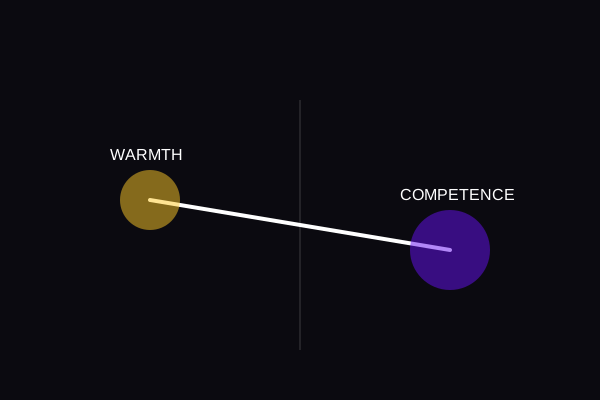
In social psychology, there is a fundamental framework called the Stereotype Content Model. It explains that we judge everyone we meet on two primary dimensions: Warmth (Are they a friend?) and Competence (Can they actually do the job?). Emojis are the ultimate hack for driving warmth, but if you're not careful, they can be the direct enemy of your perceived competence.
The "Intelligence" Tax: A 2017 Reality Check
A landmark study published in Social Psychological and Personality Science dropped a bombshell on the "friendly" workplace. Researchers found that adding a smiley face (😊) to a professional email increased perceived warmth, but significantly decreased perceived competence.
Basically, when you use a smiley, you look nice, but you also look less smart. This creates a "Likeability Trap." For leaders, the question isn't whether to use them, but *when* to pay the intelligence tax for the sake of team morale.
"Contrary to actual smiles, smileys do not increase perceptions of warmth and actually decrease perceptions of competence."
Managing Your "Emoji Capital": The Power Dynamic
The impact of a single icon is determined entirely by the Power Gap between the sender and the receiver. It's a game of status signaling.
Downward Direction (Boss -> Team)
When a superior uses a 👍 or ✅, it functions as Social Validation. It reduces employee anxiety and signals alignment. It's a low-risk, high-reward move.
Upward Direction (Team -> Boss)
When a junior uses a 🤷 or 😂 with a senior they don't know well, it signals informal entitlement. It can be read as a lack of respect for the hierarchy. Proceed with extreme caution.
Industry Tribalism: Where Symbols Build (or Kill) Trust
Trust isn't a universal language. It's an industry dialect. What builds rapport in a Silicon Valley Slack channel will destroy a relationship in a Zurich law firm.
| Industry | Trust Metric | The "Expert" Move |
|---|---|---|
| Fintech / Design | Energy & Vision | 🚀, 🔥, ✨. These symbols signal "momentum." In fast-moving sectors, looking stiff is the same as looking slow. |
| Medicine / Law | Precision & Gravity | Plain Text. If your surgeon types "Ready for your op! 🔪💉," your cortisol levels don't go down—they go up. Trust here comes from silence and sobriety. |
| Real Estate / Sales | Rapport & Value | 🤝, 🏡, 🗝️. Trust is built on personal connection. Emojis act as digital "handshakes" to bridge the physical gap between strangers. |
The "Conflict Mitigation" Hack
While the competence hit is real, emojis are the undisputed champions of De-escalation. In a remote-first world, a period at the end of a sentence can look like an act of aggression. Managers who use "softening" emojis (🧐, 🙏, 🤝) when delivering constructive criticism find that their teams are 30% more likely to implement the feedback without taking it personally.
"I need those reports by 5." (Feels like a demand.)
"I need those reports by 5! ⏳" (Feels like a shared deadline.)
Conclusion: Become a Linguistic Architect
Don't be a passive user of digital symbols. Be an architect of perception. Use emojis when you need to bridge an emotional gap, but retreat to the precision of plain text when you need to project ultimate authority. Trust isn't about being "nice"—it's about demonstrating that you know exactly which frequency of communication the current situation requires.